WBS for Project Management
In the high-stakes world of project management, complexity is often the enemy of execution. Whether you are launching a new software application or constructing a skyscraper, the sheer volume of tasks can be overwhelming. Consequently, a Work Breakdown Structure (WBS) becomes indispensable for staying organized. This tool helps you trim costs and identify risks during the early stages of a project.
What is a WBS?
At its core, a Work Breakdown Structure is a hierarchical decomposition of the total scope of work to be carried out by the project team. It starts with the final deliverable at the top and breaks it down into smaller, more manageable components called “work packages.”
Why is it Critical?
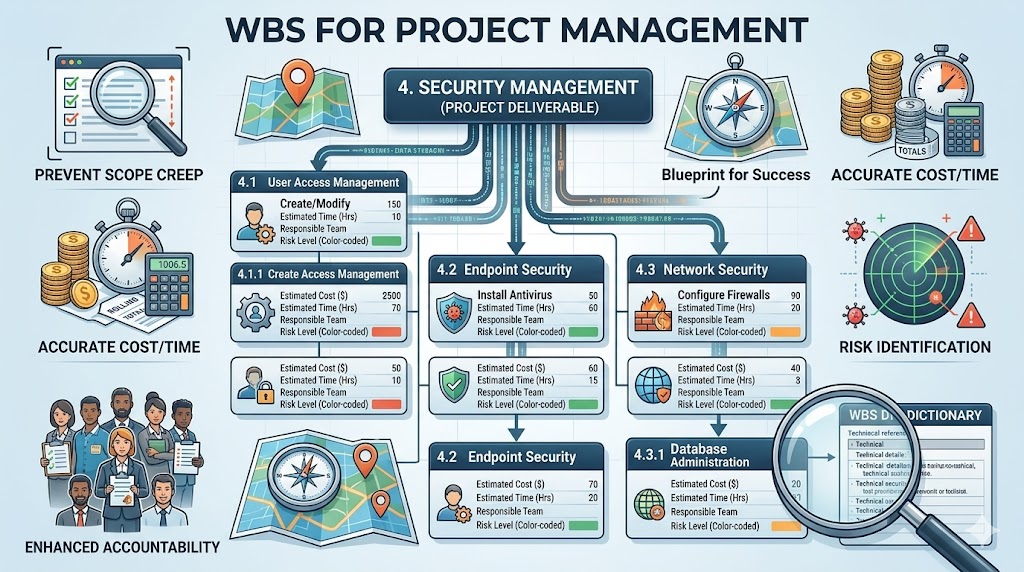
1. Clarity and Scope Definition The WBS acts as the “single source of truth” for the project. Visually mapping every deliverable, it prevents scope creep. In other words, it stops the project from growing beyond its original goals. If a task isn’t on the WBS, it simply isn’t part of the project.
2. Accurate Cost and Time Estimation. Project managers find it nearly impossible to estimate the cost of a “New Security System” as a single item. However, you can easily estimate a specific task like “4.3.1 Configure Firewalls.” Because you break the project into small chunks, you can create a highly accurate bottom-up budget.
3. Enhanced Accountability A WBS allows you to assign work packages directly to specific teams. As a result, this clear ownership ensures that no task falls through the cracks. It also provides a clear line of communication for status updates.
4. Risk Identification As you break a project into granular parts, hidden risks often emerge. For instance, you might realize a specific sub-task requires a skill set your team currently lacks. This allows you to mitigate that risk before it becomes a crisis.
The Work Breakdown Structure Dictionary: The Missing Piece
While the WBS shows what needs to be done, the WBS Dictionary explains how and to what standard. It provides the technical specifications, acceptance criteria, and resource requirements for each work package, ensuring that “done” means the same thing to everyone involved.
Take Home
A project without a Work Breakdown Structure is like a traveler without a map. It may feel faster to start moving immediately, but without a structured breakdown of the journey, you are likely to get lost, run out of resources, or arrive at the wrong destination. For any project manager, as I quoted in my previous post, “Failing to plan is planning to fail.” Again, without a solid plan, projects drift, scope creeps, deadlines slip, and costs spiral. The WBS is not just a document—it is the blueprint for success.